An Architects Space

The brief invites us to submit innovative proposals to rethink the workspace of an Architect. To propose projects that addresses the Architect's vision of his or her ideal inspiration and working space. My response to that is more pragmatic. Although it says "ideal inspiration and working space", I believe in most cases that would come later in the lifetime of a practice. The start up costs and time limitations may put the design of one's own workspace further down on the list of priorities. I started by looking at the processes within a practice and the necessities in order to design. This project provided me with an opportunity to learn Revit and expand my knowledge of the BIM software package.

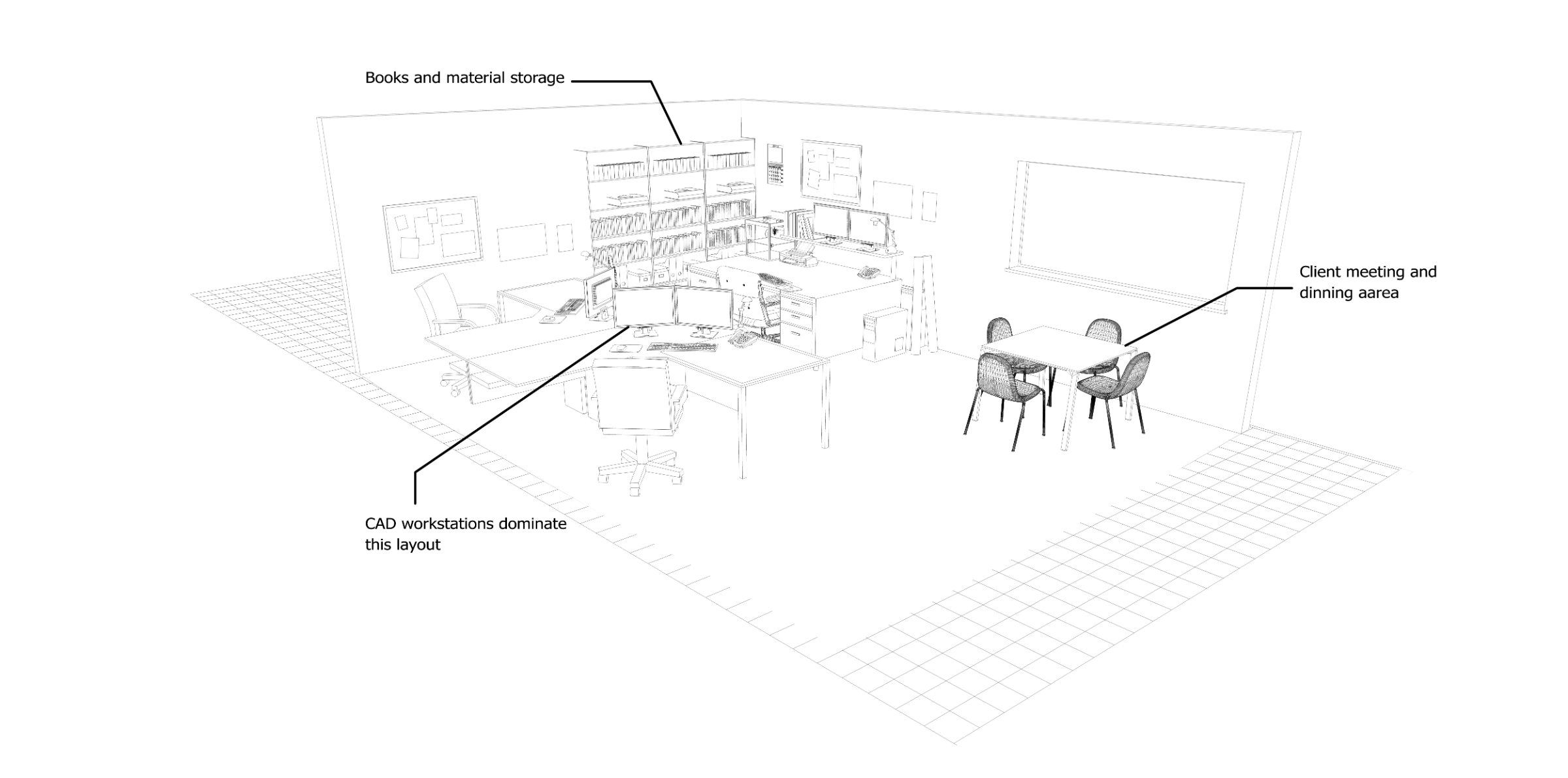
After looking at examples of existing workspaces and architectural studio premises, I identified equipment and activities that are needed or take place within the practice and then categorised these into whether they are group or solitary acts., however as the practice would grow these activities that may be solitary or small would grow too.

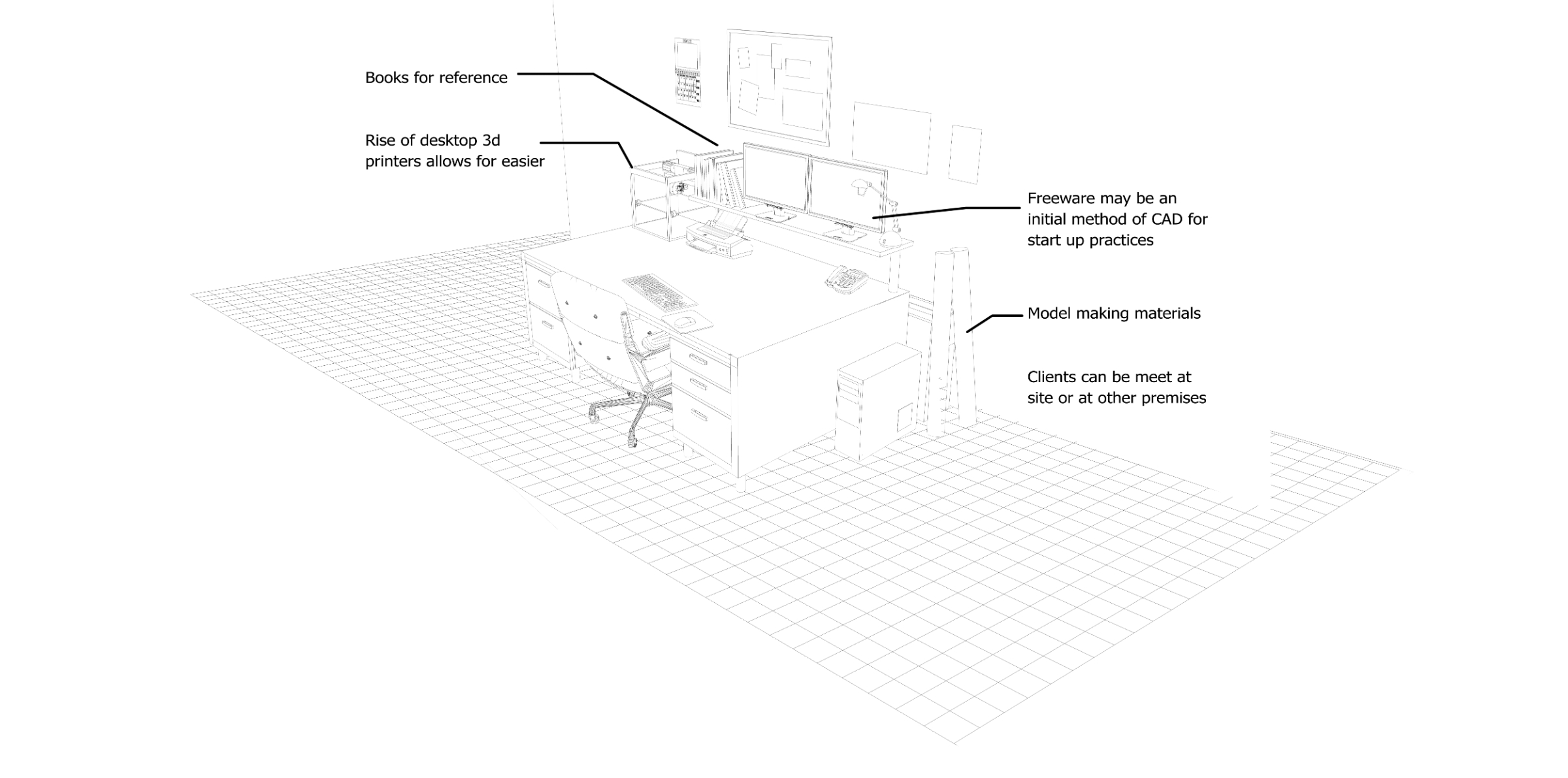
My next step was to prioritise the equipment or activities, in terms of whether they were a necessity or a luxury depending on the size of the practice.

I started looking at a maturing business and how its premises could evolve with it. I started off by looking at priorities of which space would be needed. In all cases the workshop could fit all processes in comfortably and as the practice matured then add areas specifically for CAD Suites, Storage and Client reception areas. I measured out the space each area would require and moved them round to create basic compositions.

Small Size Practice As an early business, size and cost of the premises may be restricted, therefore the scale and types of work may be hindered. However space can be used for multiple purpose, rather than just having a long board table opting for a large circular table could be better suited for multiple roles such as modelling, photography, meetings even lunch area. Using steel frame allows for further extension of the premises at a later date. The steel frame is also an architectural splurge to help create an interesting facade and semantically directs people to the entrance, as well as fulfilling a structural role.
Medium Size Practice As stated in my spatial studies this workshop can support all process of design, this is made easy by making it open plan if more space was needed for a particular job things can be moved to suit. Using a steel frame structure and a brick skin, the building can be adapted easily in the future as the practice grows. The tall glass curtain facade allows a lot of light to penetrate deep into the interior allowing for the opportunity for natural lighting and heating of the space. The tall interior of the space allows for future growth within the envelope of the current building.
Larger Size Practice This larger more established design evolved from the previous medium sized practice and is more complex in terms of how extra space has been gained. A first floor has been added within the tall workshop to allow a CAD Suite to be moved to a separate area, this allows for more space for workshop activities and storage. Access to the roof can be gained from a room that can be utilised for relaxation or dining or an area to work in a more quiet setting. The atrium on Elevation 1 allows elevator access but also a reception area in to the building. The building makes the spiral staircase at the centre and the elevators protruding through the facade an architectural feature of the building. As most of the building is very utilitarian however, these stairs and elevators are as beautiful as they are functional. This splurge on aesthetic works with my earlier pragmatic view as these additions would be easy to make in a larger practice.
An Architects Space
My next step was to prioritise the equipment or activities, in terms of whether they were a necessity or a luxury depending on the size of the practice.
Small Size Practice As an early business, size and cost of the premises may be restricted, therefore the scale and types of work may be hindered. However space can be used for multiple purpose, rather than just having a long board table opting for a large circular table could be better suited for multiple roles such as modelling, photography, meetings even lunch area. Using steel frame allows for further extension of the premises at a later date. The steel frame is also an architectural splurge to help create an interesting facade and semantically directs people to the entrance, as well as fulfilling a structural role.
Medium Size Practice As stated in my spatial studies this workshop can support all process of design, this is made easy by making it open plan if more space was needed for a particular job things can be moved to suit. Using a steel frame structure and a brick skin, the building can be adapted easily in the future as the practice grows. The tall glass curtain facade allows a lot of light to penetrate deep into the interior allowing for the opportunity for natural lighting and heating of the space. The tall interior of the space allows for future growth within the envelope of the current building.
Larger Size Practice This larger more established design evolved from the previous medium sized practice and is more complex in terms of how extra space has been gained. A first floor has been added within the tall workshop to allow a CAD Suite to be moved to a separate area, this allows for more space for workshop activities and storage. Access to the roof can be gained from a room that can be utilised for relaxation or dining or an area to work in a more quiet setting. The atrium on Elevation 1 allows elevator access but also a reception area in to the building. The building makes the spiral staircase at the centre and the elevators protruding through the facade an architectural feature of the building. As most of the building is very utilitarian however, these stairs and elevators are as beautiful as they are functional. This splurge on aesthetic works with my earlier pragmatic view as these additions would be easy to make in a larger practice.
An Architects Space
My next step was to prioritise the equipment or activities, in terms of whether they were a necessity or a luxury depending on the size of the practice.
Small Size Practice As an early business, size and cost of the premises may be restricted, therefore the scale and types of work may be hindered. However space can be used for multiple purpose, rather than just having a long board table opting for a large circular table could be better suited for multiple roles such as modelling, photography, meetings even lunch area. Using steel frame allows for further extension of the premises at a later date. The steel frame is also an architectural splurge to help create an interesting facade and semantically directs people to the entrance, as well as fulfilling a structural role.
Medium Size Practice As stated in my spatial studies this workshop can support all process of design, this is made easy by making it open plan if more space was needed for a particular job things can be moved to suit. Using a steel frame structure and a brick skin, the building can be adapted easily in the future as the practice grows. The tall glass curtain facade allows a lot of light to penetrate deep into the interior allowing for the opportunity for natural lighting and heating of the space. The tall interior of the space allows for future growth within the envelope of the current building.
Larger Size Practice This larger more established design evolved from the previous medium sized practice and is more complex in terms of how extra space has been gained. A first floor has been added within the tall workshop to allow a CAD Suite to be moved to a separate area, this allows for more space for workshop activities and storage. Access to the roof can be gained from a room that can be utilised for relaxation or dining or an area to work in a more quiet setting. The atrium on Elevation 1 allows elevator access but also a reception area in to the building. The building makes the spiral staircase at the centre and the elevators protruding through the facade an architectural feature of the building. As most of the building is very utilitarian however, these stairs and elevators are as beautiful as they are functional. This splurge on aesthetic works with my earlier pragmatic view as these additions would be easy to make in a larger practice.
An Architects Space
My next step was to prioritise the equipment or activities, in terms of whether they were a necessity or a luxury depending on the size of the practice.
Small Size Practice As an early business, size and cost of the premises may be restricted, therefore the scale and types of work may be hindered. However space can be used for multiple purpose, rather than just having a long board table opting for a large circular table could be better suited for multiple roles such as modelling, photography, meetings even lunch area. Using steel frame allows for further extension of the premises at a later date. The steel frame is also an architectural splurge to help create an interesting facade and semantically directs people to the entrance, as well as fulfilling a structural role.
Medium Size Practice As stated in my spatial studies this workshop can support all process of design, this is made easy by making it open plan if more space was needed for a particular job things can be moved to suit. Using a steel frame structure and a brick skin, the building can be adapted easily in the future as the practice grows. The tall glass curtain facade allows a lot of light to penetrate deep into the interior allowing for the opportunity for natural lighting and heating of the space. The tall interior of the space allows for future growth within the envelope of the current building.
Larger Size Practice This larger more established design evolved from the previous medium sized practice and is more complex in terms of how extra space has been gained. A first floor has been added within the tall workshop to allow a CAD Suite to be moved to a separate area, this allows for more space for workshop activities and storage. Access to the roof can be gained from a room that can be utilised for relaxation or dining or an area to work in a more quiet setting. The atrium on Elevation 1 allows elevator access but also a reception area in to the building. The building makes the spiral staircase at the centre and the elevators protruding through the facade an architectural feature of the building. As most of the building is very utilitarian however, these stairs and elevators are as beautiful as they are functional. This splurge on aesthetic works with my earlier pragmatic view as these additions would be easy to make in a larger practice.
An Architects Space
My next step was to prioritise the equipment or activities, in terms of whether they were a necessity or a luxury depending on the size of the practice.
Small Size Practice As an early business, size and cost of the premises may be restricted, therefore the scale and types of work may be hindered. However space can be used for multiple purpose, rather than just having a long board table opting for a large circular table could be better suited for multiple roles such as modelling, photography, meetings even lunch area. Using steel frame allows for further extension of the premises at a later date. The steel frame is also an architectural splurge to help create an interesting facade and semantically directs people to the entrance, as well as fulfilling a structural role.
Medium Size Practice As stated in my spatial studies this workshop can support all process of design, this is made easy by making it open plan if more space was needed for a particular job things can be moved to suit. Using a steel frame structure and a brick skin, the building can be adapted easily in the future as the practice grows. The tall glass curtain facade allows a lot of light to penetrate deep into the interior allowing for the opportunity for natural lighting and heating of the space. The tall interior of the space allows for future growth within the envelope of the current building.
Larger Size Practice This larger more established design evolved from the previous medium sized practice and is more complex in terms of how extra space has been gained. A first floor has been added within the tall workshop to allow a CAD Suite to be moved to a separate area, this allows for more space for workshop activities and storage. Access to the roof can be gained from a room that can be utilised for relaxation or dining or an area to work in a more quiet setting. The atrium on Elevation 1 allows elevator access but also a reception area in to the building. The building makes the spiral staircase at the centre and the elevators protruding through the facade an architectural feature of the building. As most of the building is very utilitarian however, these stairs and elevators are as beautiful as they are functional. This splurge on aesthetic works with my earlier pragmatic view as these additions would be easy to make in a larger practice.
An Architects Space
My next step was to prioritise the equipment or activities, in terms of whether they were a necessity or a luxury depending on the size of the practice.
Small Size Practice As an early business, size and cost of the premises may be restricted, therefore the scale and types of work may be hindered. However space can be used for multiple purpose, rather than just having a long board table opting for a large circular table could be better suited for multiple roles such as modelling, photography, meetings even lunch area. Using steel frame allows for further extension of the premises at a later date. The steel frame is also an architectural splurge to help create an interesting facade and semantically directs people to the entrance, as well as fulfilling a structural role.
Medium Size Practice As stated in my spatial studies this workshop can support all process of design, this is made easy by making it open plan if more space was needed for a particular job things can be moved to suit. Using a steel frame structure and a brick skin, the building can be adapted easily in the future as the practice grows. The tall glass curtain facade allows a lot of light to penetrate deep into the interior allowing for the opportunity for natural lighting and heating of the space. The tall interior of the space allows for future growth within the envelope of the current building.
Larger Size Practice
This larger more established design evolved from the previous medium sized practice and is more complex in terms of how extra space has been gained. A first floor has been added within the tall workshop to allow a CAD Suite to be moved to a separate area, this allows for more space for workshop activities and storage. Access to the roof can be gained from a room that can be utilised for relaxation or dining or an area to work in a more quiet setting. The atrium on Elevation 1 allows elevator access but also a reception area in to the building. The building makes the spiral staircase at the centre and the elevators protruding through the facade an architectural feature of the building. As most of the building is very utilitarian however, these stairs and elevators are as beautiful as they are functional. This splurge on aesthetic works with my earlier pragmatic view as these additions would be easy to make in a larger practice.
An Architects Space
My next step was to prioritise the equipment or activities, in terms of whether they were a necessity or a luxury depending on the size of the practice.
Small Size Practice As an early business, size and cost of the premises may be restricted, therefore the scale and types of work may be hindered. However space can be used for multiple purpose, rather than just having a long board table opting for a large circular table could be better suited for multiple roles such as modelling, photography, meetings even lunch area. Using steel frame allows for further extension of the premises at a later date. The steel frame is also an architectural splurge to help create an interesting facade and semantically directs people to the entrance, as well as fulfilling a structural role.
Medium Size Practice As stated in my spatial studies this workshop can support all process of design, this is made easy by making it open plan if more space was needed for a particular job things can be moved to suit. Using a steel frame structure and a brick skin, the building can be adapted easily in the future as the practice grows. The tall glass curtain facade allows a lot of light to penetrate deep into the interior allowing for the opportunity for natural lighting and heating of the space. The tall interior of the space allows for future growth within the envelope of the current building.
Larger Size Practice This larger more established design evolved from the previous medium sized practice and is more complex in terms of how extra space has been gained. A first floor has been added within the tall workshop to allow a CAD Suite to be moved to a separate area, this allows for more space for workshop activities and storage. Access to the roof can be gained from a room that can be utilised for relaxation or dining or an area to work in a more quiet setting. The atrium on Elevation 1 allows elevator access but also a reception area in to the building. The building makes the spiral staircase at the centre and the elevators protruding through the facade an architectural feature of the building. As most of the building is very utilitarian however, these stairs and elevators are as beautiful as they are functional. This splurge on aesthetic works with my earlier pragmatic view as these additions would be easy to make in a larger practice.
An Architects Space
My next step was to prioritise the equipment or activities, in terms of whether they were a necessity or a luxury depending on the size of the practice.
Small Size Practice As an early business, size and cost of the premises may be restricted, therefore the scale and types of work may be hindered. However space can be used for multiple purpose, rather than just having a long board table opting for a large circular table could be better suited for multiple roles such as modelling, photography, meetings even lunch area. Using steel frame allows for further extension of the premises at a later date. The steel frame is also an architectural splurge to help create an interesting facade and semantically directs people to the entrance, as well as fulfilling a structural role.
Medium Size Practice As stated in my spatial studies this workshop can support all process of design, this is made easy by making it open plan if more space was needed for a particular job things can be moved to suit. Using a steel frame structure and a brick skin, the building can be adapted easily in the future as the practice grows. The tall glass curtain facade allows a lot of light to penetrate deep into the interior allowing for the opportunity for natural lighting and heating of the space. The tall interior of the space allows for future growth within the envelope of the current building.
Larger Size Practice This larger more established design evolved from the previous medium sized practice and is more complex in terms of how extra space has been gained. A first floor has been added within the tall workshop to allow a CAD Suite to be moved to a separate area, this allows for more space for workshop activities and storage. Access to the roof can be gained from a room that can be utilised for relaxation or dining or an area to work in a more quiet setting. The atrium on Elevation 1 allows elevator access but also a reception area in to the building. The building makes the spiral staircase at the centre and the elevators protruding through the facade an architectural feature of the building. As most of the building is very utilitarian however, these stairs and elevators are as beautiful as they are functional. This splurge on aesthetic works with my earlier pragmatic view as these additions would be easy to make in a larger practice.